Uom
Manage units of measurement
On this page
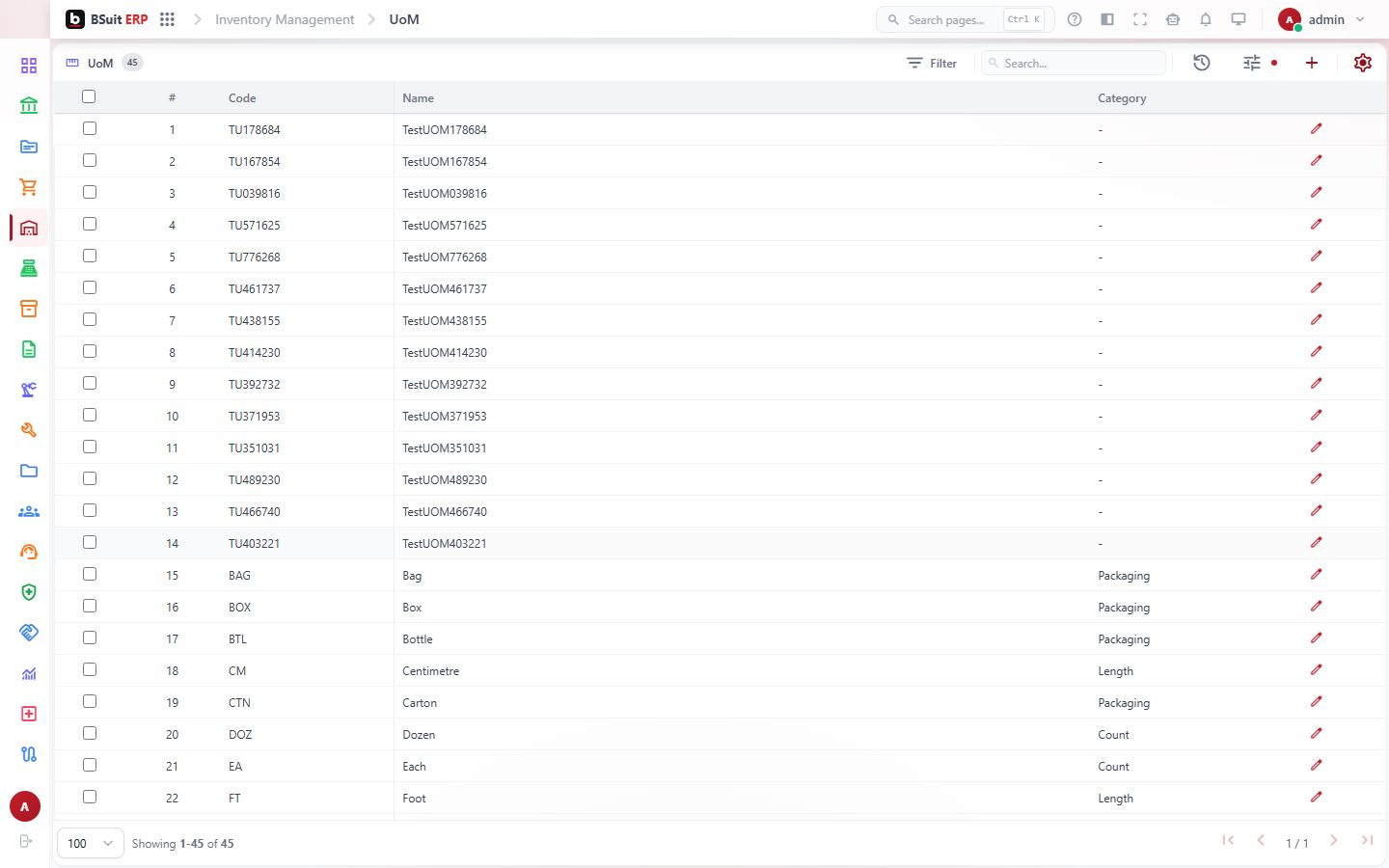
#About Uom
Manage units of measurement. This is a working page: a list or workspace where you find and act on records in BSuit ERP (Inventory & Warehouse). It is used by staff (internal users). What you can see and do depends on your role and permissions.
#How to open it
In BSuit ERP, open Inventory & Warehouse and choose “Uom”, or go directly to the address /inventory-management/uom.
#What you can do here
These controls are present in the page’s implementation. Whether you see a given one also depends on your permissions and on the data shown.
- Add new records — a form opens for the details.
- Change existing records.
- Delete records (you are asked to confirm).
- Bring records in from a file.
- Export what you see to a file.
- Print or save as PDF.
- Attach or upload files.
- Search within the page.
- Filter the data shown.
- Sort by a column.
- Page through long lists.
- Open dialogs or drawers for detail and confirmation.
#Fields
When you enter or change an uom, these fields are on the form. Required fields must be completed before you can save.
| Field | Type | Required | Details | Refers to |
|---|---|---|---|---|
| UOM Code | text | Yes | Example: e.g., KG. | — |
| UOM Name | text | Yes | Example: e.g., Kilogram. | — |
| Category | select | No | One of: Quantity, Weight, Length, Area, Volume, Time. | — |
#Data stored for each record
The full list of 9 stored fields, including ones not shown on the form, is in the Uom data reference.
#Where Uom is used as a reference
Records from this master are picked in these other forms, so changing or deleting one can affect them:
| Form | Field |
|---|---|
| Packing Boxes | UOM |
| Pick Tasks | UOM |
#What the list shows
The list displays these columns; use search and filters to narrow it.
- Code
- Name
- Category
#How to add an uom
Steps follow this page’s form. You need permission to create records here.
- Open Inventory & Warehouse › Uom from the menu.
- Choose the Add button (a plus icon) above the list. The form opens in a dialog.
- Complete the required fields: UOM Code, UOM Name.
- Some fields offer a fixed list: Category: Quantity, Weight, Length, Area, Volume, Time.
- Save. The new record appears in the list; use search or the filters to find it again.
- To change it later, open the record from the list and edit it.
- Deleting asks you to confirm. Records that other records refer to may be refused or may affect them (see “Where … is used as a reference”).
#Observed on a running system
On 2026-09-21 this page was opened in a browser as a test administrator and did not load cleanly: blank.
#If something is missing or fails
- No data: confirm the company or context selected in the top bar, and any filters or date range in use.
- An action is hidden or disabled: it usually needs a permission your role does not have. Ask an administrator to check your effective access.
- An error message appears: note the message, the page address and what you were doing, and contact support with those details (never include passwords).
#About this guide
This guide was generated from the page’s implementation. It has not yet been reviewed by a person against a running system, so treat it as a reference for what the page contains rather than a complete procedure.
About this guide
- Status
- Partially reviewed
- Application
- BSuit ERP
- Audience
- Staff (internal users)
- Owner
- BSuit documentation team
- Reviewer
- Not yet reviewed
- Last verified
- Never
- Checked against
- Generated from source revision a36c7a086 on 2026-10-02
- Seen on a running system
- 2026-09-21 — blank
- Help version
- 2026.0.0-preview
- Guide ID
erp:/inventory-management/uom