Catalogs
Supplier hosted catalogs — header + line items on one page; active ones surface to buyers
On this page
#About Catalogs
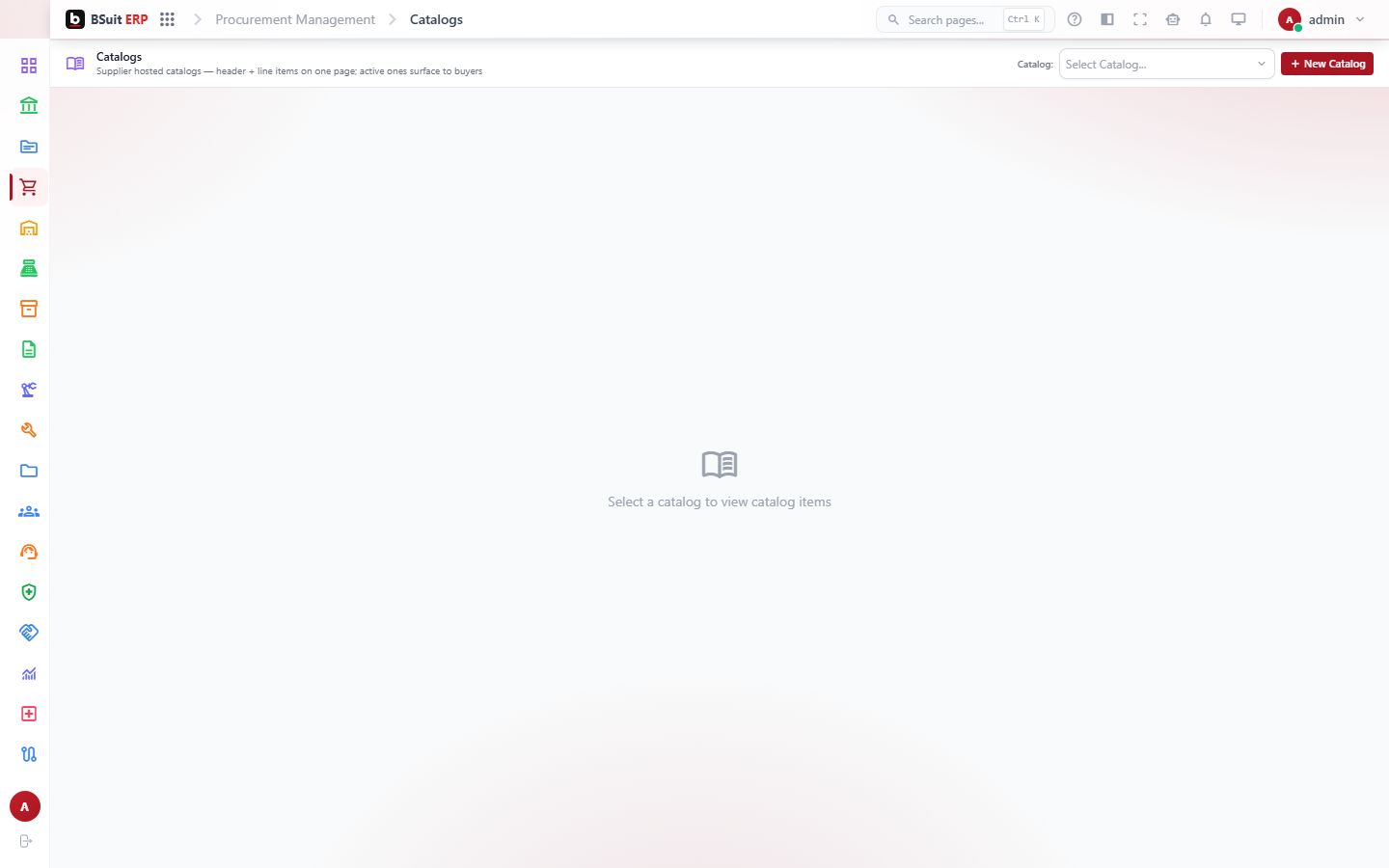
Supplier hosted catalogs — header + line items on one page; active ones surface to buyers. This is a working page: a list or workspace where you find and act on records in BSuit ERP (Procurement). It is used by staff (internal users). What you can see and do depends on your role and permissions.
#How to open it
In BSuit ERP, open Procurement and choose “Catalogs”, or go directly to the address /procurement-management/catalogs.
#What you can do here
These controls are present in the page’s implementation. Whether you see a given one also depends on your permissions and on the data shown.
- Add new records — a form opens for the details.
- Change existing records.
- Delete records (you are asked to confirm).
- Bring records in from a file.
- Search within the page.
- Open dialogs or drawers for detail and confirmation.
#Data stored for each record
The form layout of this page could not be read from its source, so here is everything BSuit stores for a catalog (see also the Catalog data reference). Which fields appear on screen depends on the page and your configuration.
| Field | Stored as | Type | Required | Max length | Refers to |
|---|---|---|---|---|---|
| Company Id | CompanyId | Text | No | — | Company |
| Supplier Id | SupplierId | Text | No | — | Supplier |
| Name | Name | Text | No | — | — |
| Description | Description | Text | No | — | — |
| Catalog Type | CatalogType | Text | No | — | — |
| Status | Status | Text | No | — | — |
| Currency Id | CurrencyId | Text | No | — | Currency |
| Effective From | EffectiveFrom | Date | No | — | — |
| Effective To | EffectiveTo | Date | No | — | — |
| Punch Out Url | PunchOutUrl | Text | No | — | — |
| Punch Out Shared Secret | PunchOutSharedSecret | Text | No | — | — |
| Notes | Notes | Text | No | — | — |
| Items | Items | Text | No | — | — |
| Id | Id | Text | No | — | — |
| Created At | CreatedAt | Date and time | No | — | — |
| Updated At | UpdatedAt | Date and time | No | — | — |
| Is Deleted | IsDeleted | Yes / No | No | — | — |
#Observed on a running system
On 2026-09-21 this page was opened in a browser as a test administrator. This is what was visible on screen under the heading “Catalogs”. Your own view can differ with your role, data and settings.
| Button |
|---|
| New Catalog |
#If something is missing or fails
- No data: confirm the company or context selected in the top bar, and any filters or date range in use.
- An action is hidden or disabled: it usually needs a permission your role does not have. Ask an administrator to check your effective access.
- An error message appears: note the message, the page address and what you were doing, and contact support with those details (never include passwords).
#About this guide
This guide was generated from the page’s implementation. It has not yet been reviewed by a person against a running system, so treat it as a reference for what the page contains rather than a complete procedure.
About this guide
- Status
- Partially reviewed
- Application
- BSuit ERP
- Audience
- Staff (internal users)
- Owner
- BSuit documentation team
- Reviewer
- Not yet reviewed
- Last verified
- Never
- Checked against
- Generated from source revision a36c7a086 on 2026-10-02
- Seen on a running system
- 2026-09-21
- Help version
- 2026.0.0-preview
- Guide ID
erp:/procurement-management/catalogs